The slide said “HR Integration” in the same font as the other twelve workstreams. Same two-line description. Same green status light. Same program manager assigned to five other things.
Six months later, the CFO was asking why synergy capture was 40% behind plan. The answer was in that slide. HR wasn’t a workstream. It was the workstream. And it had been treated like an afterthought from the start.
I’ve seen this pattern in deal after deal. IT gets the budget. Finance gets the attention. HR gets a checklist and a wish. Then the talent walks, the payroll breaks, and the works council sends a letter that makes the general counsel’s phone ring at 11pm. By then the integration is in triage, and the people who caused the problem are pointing at the green status light from six months ago as evidence that this couldn’t have been predicted.
It was predictable. It was predicted. The prediction was on slide 14 of a deck that nobody read past slide 6.
This is the playbook for how to run HR integration properly. Not the framework version. The version that comes from actually doing it.
Why HR is the hardest workstream
It’s not because the work is more complex than IT or Finance. It’s because HR integration touches every other workstream simultaneously, and the consequences of getting it wrong are both immediate and permanent.
PwC found that only 14% of companies report achieving significant M&A integration success. McKinsey attributes roughly half of integration failures to organizational and cultural misalignment. Not technology. Not finance. People.
The numbers get worse when you look at talent. MIT Sloan found that acquired employees leave at 3x the baseline rate in Year 1 (34% vs. 12%). Gallup puts preventable M&A turnover at 42%. EY says 47% of key employees leave in Year 1. By Year 3, that number is 75%.
These aren’t just HR problems. When your VP of Engineering leaves in month three, that’s a product problem. When your regional sales director takes her relationships to a competitor, that’s a revenue problem. When your IT architect who understands both legacy systems walks, that’s a systems integration problem that just became a systems archaeology problem.
HR integration is where all of this gets decided. Who stays. Who goes. What they get paid. What their org looks like. Whether they trust the new leadership. Whether they update their LinkedIn profile on Day 2. (LinkedIn profile updates are not a metric that appears in any integration playbook. They should be.)
The workforce planning gap
Workforce planning in M&A isn’t one thing. It’s five things happening at once, all connected, all urgent, and usually owned by nobody.
Org design: deciding what the combined structure looks like. Which roles exist. Which don’t. Who reports to whom. This alone is a three-month exercise for a complex deal. Talent selection runs alongside it: figuring out who fills the roles you’ve designed. Not just who’s “best” by some abstract measure, but who has the institutional knowledge, the customer relationships, and the credibility to make the combined org work. McKinsey’s research shows that about 40 transformation-critical roles create 80% of total value, and many of them aren’t senior leaders.
Then there’s retention. Keeping the people you can’t afford to lose while they’re being courted by every recruiter in the industry. Most companies throw money at this problem. Most of them throw it at the wrong people. The math behind retention bonuses is rarely what it seems.
Synergy capture is the headcount rationalization that the deal economics depend on. Function by function. Role by role. Exit with backfill vs. exit without backfill vs. productivity exit. Gross loaded cost minus severance equals net synergy. Global PMI Partners found that most headcount synergies should be locked in within 18 months.
And severance. The legal and operational complexity of actually making the reductions happen. Notice periods. Works council consultations. Country-specific rules. WARN Act compliance. In some jurisdictions, getting a single termination wrong can cost months of delay and six figures in penalties.
All five run concurrently. They depend on each other. And in most integrations, no single person owns the whole picture. The HR due diligence questions you ask before close determine how many of these surprises hit you after.
What this actually costs
Nobody publishes the real cost of HR integration. Here’s what it looks like based on EY’s 236-transaction dataset.
| Deal Size | Integration Cost (% of deal) | HR Share |
|---|---|---|
| Under $500M | 5-7% | 50-66% |
| $500M-$2B | 3-5% | 50-60% |
| $2B-$10B | 2-4% | 45-55% |
| Over $10B | 1-3% | 40-50% |
For a $3B deal, the HR integration cost stack looks roughly like this:
| Category | Estimated Cost |
|---|---|
| HRIS implementation/migration | $3-8M |
| Payroll system standup | $1-3M |
| Benefits harmonization | $2-5M |
| Retention bonuses | $15-30M |
| Change management and communications | $1-2M |
| External advisors (Mercer, WTW, etc.) | $2-5M |
| Total | $24-53M |
That’s 0.8-1.8% of deal value. Retention bonuses alone are typically 1-2% of purchase price (WTW 2024). Cross-border deals add 30-50% to the total. Carve-outs cost 2-3x more than bolt-on acquisitions because you’re building from scratch instead of absorbing into an existing structure.
Per employee, expect $3,000-8,300 in direct HR integration costs before you count productivity loss.
Retention: the math that should change your approach
The retention conversation in most deals goes like this: identify critical talent, offer bonuses, hope they stay. The standard ROI pitch is simple. It costs 2x salary to replace a senior leader. A 50% bonus is cheaper. So the ROI is 4:1. Easy.
Except that math assumes every person you’re paying would have left without the bonus. They wouldn’t have. MIT Sloan’s data suggests 66% of acquired employees stay through Year 1 without any bonus at all. The implied incremental retention from bonuses is roughly 14 percentage points. That changes the ROI dramatically.
When you run the probability-adjusted math on a broad retention program covering 100 employees, the adjusted ROI drops to 0.53:1. The program destroys value. The same math applied to a narrow, targeted program covering genuinely at-risk, genuinely critical roles shows a 2.88:1 return. The selection problem is everything.
I wrote a detailed breakdown of the retention math including who should actually receive bonuses, how to structure them, and why McKinsey says less than 2% of your workforce should get one.
Standing up HR systems: HRIS and payroll
This is where deals go to die quietly. HRIS migration sounds like an IT project. It’s not. It’s a people project disguised as a technology project, and the disguise is good enough to fool most program managers into staffing it with the wrong team.
The HRIS section of most integration plans has three platform names and some generic descriptions like “evaluate and select HR technology platform.” Here’s what it actually looks like when you open the box.
Platform reality
| Platform | Cost (per employee/month) | Deploy Timeline | Sweet Spot |
|---|---|---|---|
| Workday | $34-42 | 5-18 months | 1,000+ employees, acquirer already on Workday |
| SAP SuccessFactors | $28-38 | 3-12+ months | SAP ecosystem shops |
| UKG Pro | $25-37 | 4-8 weeks | Manufacturing with shift workers |
| ADP Workforce Now | $18-28 | 10-14 weeks | Mid-market, fastest enterprise-grade |
| Rippling | $8+ | 2-4 weeks | PE portfolio companies, HR+IT+Finance unified |
| Deel | $5+ | Days to weeks | Cross-border carve-outs, EOR for countries without entities |
Gartner says 83% of data migration projects fail or exceed their budgets and timelines. Implementation fees typically run 100-200% of the annual license cost. A 5,000-employee Workday implementation costs $1.6-2.4M in Year 1 alone.
The hidden costs nobody budgets for: 3-5 hours per 100 employee records for data extraction. Most vendors only migrate 2 years of history as standard, but compliance often requires 5-7. Internal team diversion runs $50K-150K in lost productivity. And 30% of integrations require rework after major platform updates.
Payroll is the non-negotiable
Payroll must be right. There is no “close enough” in payroll. Miss a paycheck and you’ve lost trust that takes months to rebuild. Get a tax filing wrong and you’ve created a compliance problem that follows the entity for years.
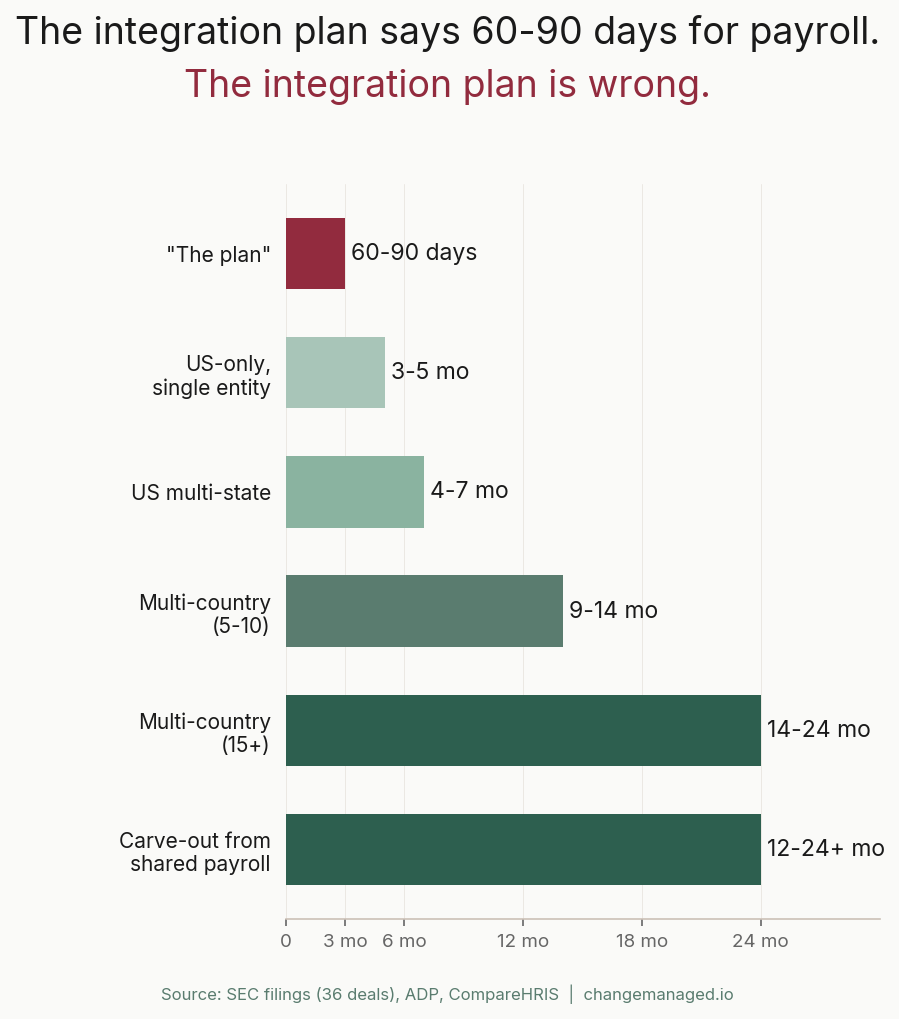
The timeline most integration plans show (60-90 days) is wrong for anything beyond the simplest scenario. Here’s what’s realistic:
| Scenario | Timeline |
|---|---|
| US-only, single entity | 3-5 months |
| US multi-state | 4-7 months |
| Multi-country (5-10) | 9-14 months |
| Multi-country (15+) | 14-24 months |
| Carve-out from shared payroll | 12-24+ months |
From publicly available SEC filing data across 36 deals and 250 service lines, the median TSA duration for HR and payroll services is 18 months. Companies negotiate 18 months because that’s how long it actually takes.
The non-negotiable: parallel payroll runs. Minimum 2 cycles, standard is 3, complex or global deals need 4 or more. For monthly payroll, 3 parallel cycles means 3 months of testing alone, on top of all implementation work. If there isn’t time for parallel testing, the go-live date moves. You don’t compress this phase.
The international trap
In a domestic deal, HR integration is hard. In a cross-border deal, it’s hard and legally treacherous.
Works councils in Germany and the Netherlands have co-determination rights over restructuring. You can’t announce a retention program, restructure a team, or implement new HR technology without consulting them first. Non-compliance under UK TUPE rules can cost up to 13 weeks’ pay per affected employee. Can you imagine the time a works council would have if they found out about a restructuring plan from a press release instead of a consultation?
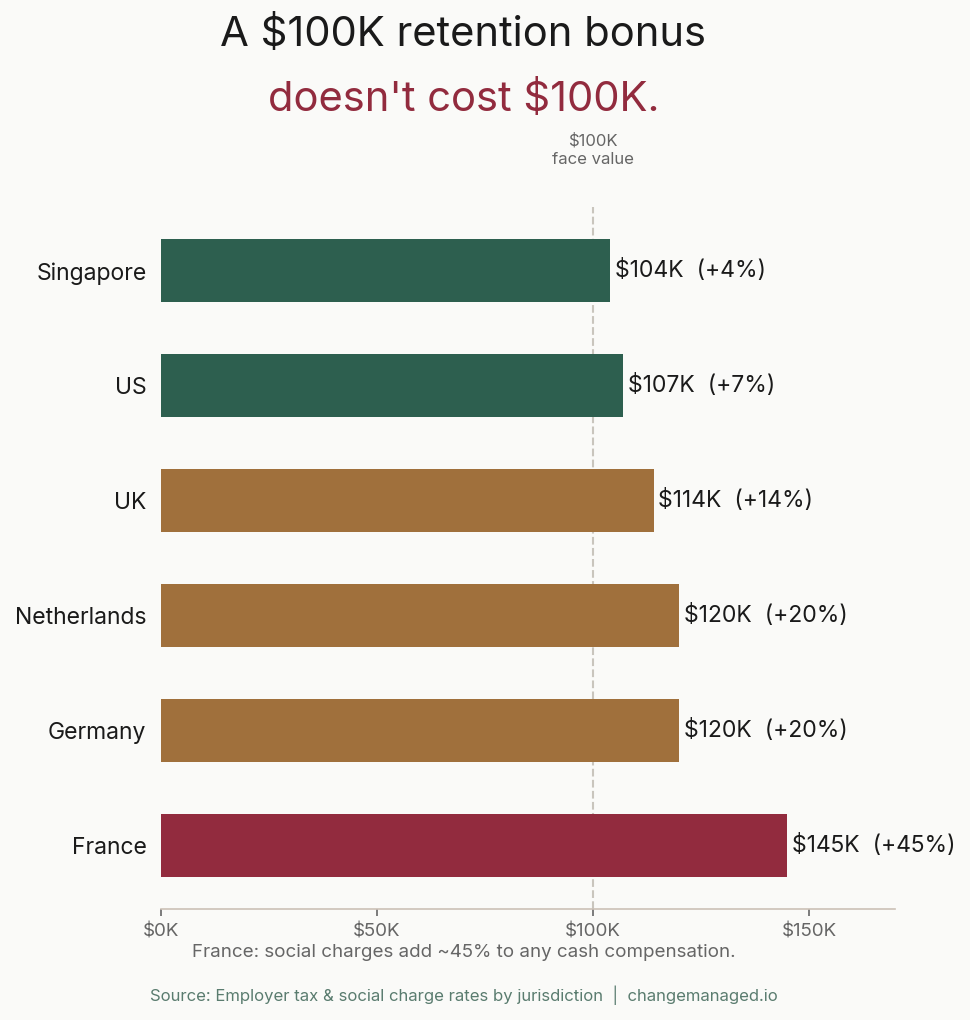
Severance varies wildly. The US is at-will with no statutory severance. Mexico requires 3 months’ salary plus 20 days per year of service. Spain caps at 33 days per year up to 24 months. These aren’t negotiable. They’re law. And employer-side costs add 20-45% above the face value of any compensation action in Europe. A $100K retention bonus costs $104K in Singapore and $145K in France once you add social charges.
Then there’s GDPR. Fines up to 4% of global annual revenue for any entity processing EU citizen data. Employee data transfer during due diligence requires careful handling. Most deal teams don’t think about this until legal tells them to stop.
Asia-Pacific severance and social insurance structures vary widely by jurisdiction and are beyond the scope of this guide, but they add a similar layer of complexity.
The practical takeaway: budget 30-50% above your domestic HR integration cost estimate for every non-US jurisdiction, and get local employment counsel involved before you announce anything.
Comp and benefits harmonization
Two employees sit next to each other doing the same job. One has the acquirer’s benefits package. The other has the target’s. They talk. Now you have a morale problem that no town hall can fix.
Benefits harmonization should be designed within the first year of close. Full comp harmonization typically takes 12-24 months. HRIS integration for comp data can stretch beyond that in complex global organizations.
The work starts with establishing a consistent total rewards philosophy. Don’t confuse integration (connecting systems) with harmonization (aligning philosophy). WTW makes this distinction clearly. You need to decide what you believe about comp before you start aligning numbers.
Areas requiring the most reconciliation: supplemental pay, premium pay, incentive structures. The gap between “our bonus is 10% of base” and “their bonus is 20% with different triggers” isn’t just math. It’s culture. And it tells people what the combined organization values.
The carve-out multiplier
Everything in this playbook gets harder in a carve-out. In a standard acquisition, you’re absorbing an existing organization into your structure. In a carve-out, you’re building a standalone company from a division that has never operated independently.
The carved-out entity often has no independent HR function, no standalone HRIS, no payroll system, and no legal entities in the countries where it employs people. All of that runs on the parent’s infrastructure under a Transition Service Agreement that gives you 12-24 months to figure it out.
I’ve written separately about carve-out readiness and what needs to happen before Day 1. The short version: start building before the deal closes, or the TSA becomes a crutch you can’t put down.
Culture: the thing everyone talks about and nobody does
Companies that manage culture effectively during integration are 50% more likely to meet synergy targets (McKinsey). Aligned cultures deliver 3x total shareholder returns compared to those without alignment. 75% of executives say cultural differences were a bigger hurdle than they anticipated (PwC).
And yet. Most culture integration consists of a town hall, a values poster designed by someone who has never worked in either organization, and a hope that people will “figure it out.”
Culture isn’t a workstream you delegate to HR and check off. It’s how decisions actually get made. How information flows. How conflict gets resolved. How success gets rewarded. When two organizations combine, you’re combining two systems of unwritten rules. If the rules conflict and nobody acknowledges it, people fill the gap with distrust.
When cultures are very different, slower and less extensive integration is more successful than forcing rapid assimilation. When cultures are similar, you can move faster. The assessment has to happen early enough to inform the integration pace.
What good looks like
The integrations I’ve seen work have a few things in common.
One person owns HR integration end to end. Not a committee. Not a working group. One senior HR leader with a direct line to the steering committee and the authority to make decisions across org design, retention, comp, and systems. This sounds obvious. It almost never happens.
Workforce planning starts during due diligence, not after close. Function-by-function overlap analysis. Preliminary synergy targets. Key talent identification. Cultural risk assessment. The more you know before Day 1, the faster you can move after it. The plan has phases, not just tasks: Day 1 readiness (payroll, benefits, access, communications), first 100 days (org design, talent selection, retention, synergy planning), months 4-12 (comp harmonization, HRIS, policy alignment), and Year 1+ (full systems integration, steady-state operations, culture measurement).
Decisions get tracked and don’t get relitigated. A decision log from Day 1. Who decided what, when, and why. This alone prevents more wasted time than any other governance tool.
And the integration team has real-time visibility into where things actually stand. Not monthly PowerPoint updates. Not quarterly board reviews. Dashboards that show workforce disposition, synergy realization, talent assessment status, and risk flags across every function and jurisdiction.
The deals that capture their intended value don’t have better frameworks. They have better execution. And execution starts with treating HR like the critical path it is, not the twelfth workstream with the same green light.
Before you get to integration, make sure due diligence covered the right ground. Here are the 20 HR due diligence questions that surface the problems the data room won’t show you.
If you’re planning an integration and HR is still a two-line item on the program slide, let’s talk. It’s the workstream that will determine whether this deal works.
Related Insights
100-Day M&A Integration Plan
100-day post-merger integration plan: stabilize (0-30), execute (31-60), accelerate (61-100). Week-by-week milestones from real transactions.
M&A Integration Checklist: Day 1 to 100
47-item post-merger integration checklist: Day 1 readiness, workstream setup, synergy tracking. From real deals, not frameworks.

Josh is a Roshco founder. 15+ years leading M&A integrations, org redesigns, and technology transformations across multiple multi-billion-dollar deals and carve-outs. Deloitte Human Capital alum. UPenn. Prosci certified. Navy veteran.
See it in action
Orgscout puts live deal intelligence behind the advisory work: dashboards, org design, and synergy tracking on real data.
Explore the platform